Topics: Insights
Published on
05. November 2026
Reading time: approx. 8 minutes
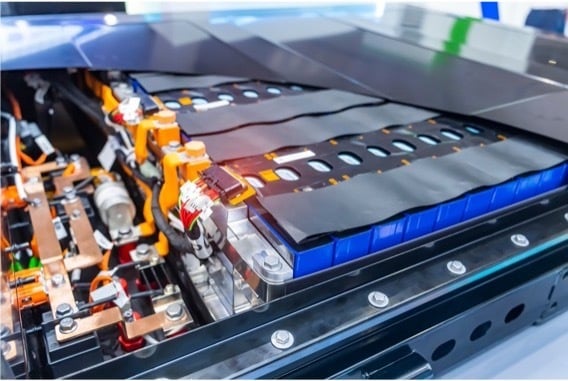
Low-ohmic precision resistors are a cornerstone component to current and power sensing, often used in battery-powered systems and motor drives. The resistors themselves must be optimized for precision to best measure current. However, they must also be optimized in accordance with the specific requirements of their end application.
Aerospace and defense-related standards and regulations for these components present unique challenges to their design and development. With these challenges of implementing current-sense resistors in aerospace applications, though, come opportunities for manufacturers of thermal alloys as well as power and precision resistors to innovate and solve.
Current-sense Resistor Considerations
Resistors can technically be used to measure current and, therefore, power by means of Ohm’s law. However, these current-sensing components will inevitably heat up as current passes through them. Supporting low resistance values will help with this self-heating issue, but there are far more considerations for these specialized components over standard, run-of-the-mill resistors.
For one, precision is paramount. This means that the resistance value should not deviate significantly from the specified value over temperature and aging. The materials used in the low-ohmic precision resistors and the integrity of their overall construction should be optimized. Employing alloys with a low temperature coefficient of resistance (TCR) ensures minimal expansion under heat, maintaining consistent resistance and long-term stability.
Isabellenhütte is experienced in developing high-reliability current-sense resistors for mission-critical applications in the industrial, medical, automotive, and aerospace sectors.
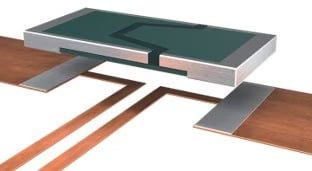
Low-ohmic chip shunt resistors offer a platform for current sensing when integrated in a circuit. Source: Isabellenhütte
Aerospace and Defense Considerations
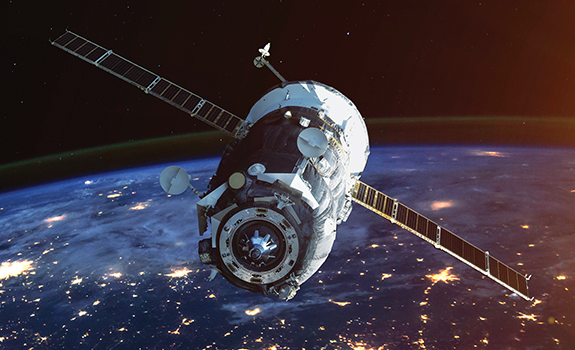
The demands of the aerospace environment diverge significantly from those of terrestrial equipment. Equipment is exposed to a spectrum of radiation — from ultraviolet (UV) to electromagnetic (EM) — especially at higher altitudes or in orbit.
Different orbits present different radiation environments. Exposure varies by mission life, deployment timing (e.g., solar maximum or minimum), and operational subsystems.
Historically, space electronics were a niche field. But the NewSpace trend has democratized it, with smaller companies launching short-life satellites or developing drone technologies. These often use radiation-tolerant rather than fully hardened components for cost and speed.
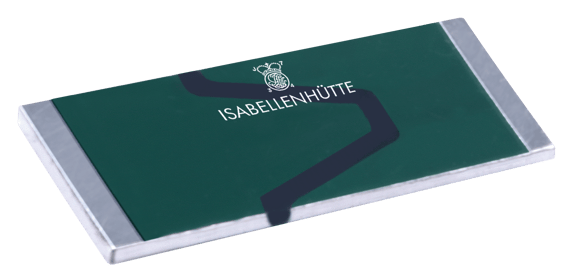
The 0.005 Ω to 1 Ω VMS precision and power resistor with a tin-leadcontact plating for applicability in aerospace and defense. Source: Isabellenhütte
The DLA and ESCC
The Defense and Logistics Agency (DLA) in the U.S. audits and qualifies space-grade components. Approved parts appear on the Qualified Products List (QPL), meeting strict qualification requirements.
In Europe, the European Space Agency (ESA) uses the European Space Components Coordination (ESCC) to formalize standards and qualification for EEE space components.
Isabellenhütte’s VMx series has been DLA-approved and used in spacecraft, commercial, and military aircraft. The SMx series is certified by the ESCC. Both use tin-lead (SnPb) terminals and undergo extensive testing, with reciprocal qualifications across space agencies.
Specification Table: Aerospace-Approved Resistors
| Series | Wattage | Package Size | Resistance Range (mΩ) | TCR (ppm/K) | Specification |
|---|---|---|---|---|---|
| SMP-PW | 1 | 2010 | 5 to 1K | 50 to 100 | ESCC 4001/027 |
| SMS-PW | 2 | 2512 | 5 to 1K | 50 to 100 | ESCC 4001/027 |
| SMT-PW | 3 | 2817 | 4 to 4.7K | 50 to 100 | ESCC 4001/027 |
| SMV-PW | 3 | 4723 | 3.3 to 1K | 30 to 50 | ESCC 4001/028 |
| VMI-M | 0.5 | 0805 | 10 to 50 | 30 to 50 | DLA 25003 |
| VMK-M | 0.75 | 1206 | 10 to 470 | 20 | DLA 25004 |
| VMP-M | 1.5 | 2010 | 5 to 1K | 20 | DLA 25005 |
| VMS-M | 2 | 2512 | 5 to 1K | 20 | DLA 25006 |
Space-Specific Failure Mode: Tin Whiskering
In space, tin whiskers—tendril-like growths—can form on pure tin or tin-alloy components (especially with >97% tin content). These whiskers can cause short circuits, leading to catastrophic failures. Vaporized tin may create plasma arcs carrying hundreds of amps.
According to NASA, three in-orbit satellite failures have been linked to tin whiskers. Tin remains essential in electronics (solder, connectors, plating), so the solution is SnPb plating, which inhibits whisker growth.
DLA states: “Alloys of 3% lead, by mass, have shown to inhibit the growth of tin whiskers.”
Applications
Precision current-sense resistors serve key roles in:
- Battery Management Systems (BMS): Monitor current flow accurately.
- Motor Drives & Inverters: Convert DC to AC and require phase current monitoring.
- Satellites: Use resistors with actuators and solar-powered battery packs.
- Drones & eVTOLs: Need compact, lightweight components for optimal SWaP (Size, Weight, and Power).
The Isabellenhütte Advantage
Space-grade components must meet specific environmental and regulatory benchmarks. Isabellenhütte’s VMx and SMx series offer:
- Low TCR for precision and stability
- SnPb contacts for enhanced reliability
- DLA and ESCC certifications
To learn more about the VMx series of low-ohmic precision and power resistors, contact Isabellenhütte.
FAQs
What makes low-ohmic precision resistors suitable for aerospace and defense applications?
Low-ohmic precision resistors are designed for high accuracy and stability, with low temperature coefficients (TCR) and tin-lead (SnPb) plating to reduce tin whisker formation. These features make them ideal for high-reliability aerospace and defense environments.
Why is tin whisker growth a concern in space applications?Tin whiskers can cause short circuits and metal vapor arcs in space due to the vacuum environment. These failures can be catastrophic, which is why tin-lead plating is used to mitigate their formation in critical components.
What’s the difference between DLA and ESCC qualifications?DLA (Defense Logistics Agency) qualifications are used in the U.S. for space-grade components, while ESCC (European Space Components Coordination) serves a similar role in Europe under the ESA. Both certify that components meet stringent aerospace standards.
How do these resistors support battery management and motor drive systems?Precision resistors accurately measure current in battery management systems and inverters, ensuring proper performance, safety, and energy efficiency in aerospace electronics.
What resistor series from Isabellenhütte are qualified for aerospace use?The VMx series is DLA-qualified, and the SMx series is ESCC-certified. Both are engineered with high stability, low TCR, and tin-lead terminals for aerospace and defense use.